Summary of the Previous Session
In the previous session, we examined essential components of experimental design, particularly focusing on sample size determination and statistical power. These elements ensure that studies are designed with sufficient observations to detect meaningful effects while minimizing errors. This approach emphasized refining methodologies for analyzing experimental results and ensuring reliability through robust statistical practices.
In this session, we shift our focus to optimizing the intervention itself. The Multiphase Optimization Strategy (MOST) introduces a systematic framework for developing, optimizing, and evaluating interventions by iteratively testing individual components and their interactions. Unlike traditional randomized controlled trials (RCTs), which primarily assess the overall efficacy of an intervention, MOST emphasizes identifying the most effective, efficient, and scalable components of an intervention. By bridging these perspectives, we move from refining how we evaluate interventions to understanding how to design them for maximum impact in real-world applications.
Introduction to MOST
Suppose we designed an app for University of Miami students to reduce stress, but after running a randomized controlled trial (RCT), the results were weaker than expected. What are some reasons this might have happened?
Poor Fit of Components: Some components of the intervention might not align well with the target audience’s needs or preferences.
Lack of Engagement: Users may not find the app engaging enough to utilize its features consistently.
Unanticipated Interactions Between Components: Certain components may interact in unexpected ways, either amplifying or offsetting each other’s effects.
Key Conceptual Distinction Between MOST & RCT
RCTs: Focus on testing the overall effectiveness of an intervention as a complete package after it has been implemented.
Multiphase Optimization Strategy (MOST): Emphasizes developing and optimizing individual intervention components before testing the entire intervention.
Definition of a Component in MOST
In the Multiphase Optimization Strategy (MOST) framework, a component is defined as a distinct, modular element of an intervention that can be systematically tested, refined, or optimized to improve the overall effectiveness, efficiency, scalability, or affordability of the intervention.
Key Characteristics of a Component in MOST
Independently Manipulable – A component can be included, excluded, or modified without altering other components of the intervention.
Functionally Meaningful – Each component serves a specific purpose within the intervention (e.g., a reminder system in a behavioral health intervention, an incentive structure in an educational program).
Optimizable – Researchers can adjust the component’s intensity, frequency, delivery method, or other characteristics to determine its most effective configuration.
Evaluated for Contribution – MOST evaluates whether each component meaningfully contributes to the intervention’s overall effectiveness and cost-effectiveness.
Can Interact with Other Components – The effectiveness of one component may depend on the presence or absence of others, requiring factorial or other experimental designs to assess interactions.
Intervention Optimization
In MOST, the goal is to systematically test and optimize each component before assembling the final intervention package to ensure the most efficient and scalable intervention. In other words, intervention optimization is the process of identifying the intervention that provides the best expected outcome while adhering to key constraints. The first step towards optimizing the intervention is to define its components, and identify their effects, costs, and interactions. Let’s do these step by step. First, suppose in our example of the stress reduction app at University of Miami, we identify the following components:
Mindfulness Exercises: Guided meditations and breathing exercises to manage stress in real time.
Physical Activity Goals: Sets and tracks daily exercise goals with movement reminders.
Social Support Features: Provides an anonymous platform for peer support, encouragement, and advice.
In the second step, we have to determine the effects of each component, as they each target a specific stress factor.
Mindfulness Exercises: Immediate stress reduction during high-stress periods.
Physical Activity Goals: Lower cortisol levels and long-term resilience against stress.
Social Support Features: Reduces isolation and fosters connections for mental well-being.
After identifying the effects, we should identify the costs associated with each component. This could be for development, and or implementation of the component.
Mindfulness Exercises: High cost (e.g., licensing and creating high-quality audio guides).
Physical Activity Goals: Low-medium cost (e.g., smartphone-based step tracking).
Social Support Features: High cost (e.g., moderation and secure servers).
The last step is to consider how these component interaction with eachother.
Mindfulness & Physical Activity Goals: Regular mindfulness practices can enhance motivation for physical activity by reducing stress and improving focus.
Social Support & Physical Activity Goals: Social accountability enhances adherence to physical activity goals, making users more likely to achieve their exercise objectives.
Mindfulness & Social Support: Peer support can reduce the immediate need for mindfulness, as students feel less isolated and more connected.
The Four Desiderata of MOST: EASE
1. Effectiveness
Definition: Effectiveness measures how well each intervention component achieves the intended outcomes. It is the degree to which the anticipated effects are realized.
Example: In the stress reduction app, effectiveness would mean that students who engage with features like mindfulness exercises or physical activity goals report measurable stress relief. For high effectiveness, each component should reliably contribute to reduced stress as intended.
2. Affordability
Definition: Affordability (previously referred to as economy in earlier publications) assesses whether the intervention can deliver the expected outcomes while staying within budget constraints. It emphasizes optimizing costs without compromising the quality of outcomes.
Example: With a fixed budget for the app’s development, affordability would involve choosing cost-effective components that still produce measurable stress relief. For instance, mindfulness exercises might offer high affordability if they are inexpensive to implement and significantly reduce stress.
3. Scalability
Definition: Scalability is the capacity of the intervention to be implemented on a larger scale, effectively maintaining both affordability and efficiency.
Example: In the app’s context, scalability would mean that if the app successfully reduces stress among Miami students, it could be deployed to students at other universities with minimal additional cost or structural change. Features like automated mindfulness guides are more scalable than high-cost, personalized social support that may require extensive resources to expand.
4. Efficiency
Definition: Efficiency is the relationship between outcomes achieved and resources used, essentially the intervention’s productivity. It examines how much "output" (stress reduction) is gained per unit of input (e.g., time, cost, or developer effort).
Example: For the app, efficiency could involve examining if the physical activity goals feature provides substantial stress reduction for a relatively low development cost compared to the high cost of social support features. Efficient components are those that provide significant stress relief without excessive resource consumption.
With MOST, these objectives guide you to design an intervention that not only reduces stress (effectiveness) but also does so with minimal resources (efficiency), within budget (affordable), and is feasible to roll out on a larger scale (scalability).
Optimization Objective is to balance the four components of intervention EASE:
Effectiveness: Achieving weight reduction.
Affordability: Staying within budget constraints.
Scalability: Expanding to larger populations with minimal adjustments.
Efficiency: Maximizing outcomes relative to resources used.
Basiclly, which of the components or their combination should be used in the final intervention to maximize the effects while remaining within budget?
Steps in Optimization
Phase 1: Component Testing
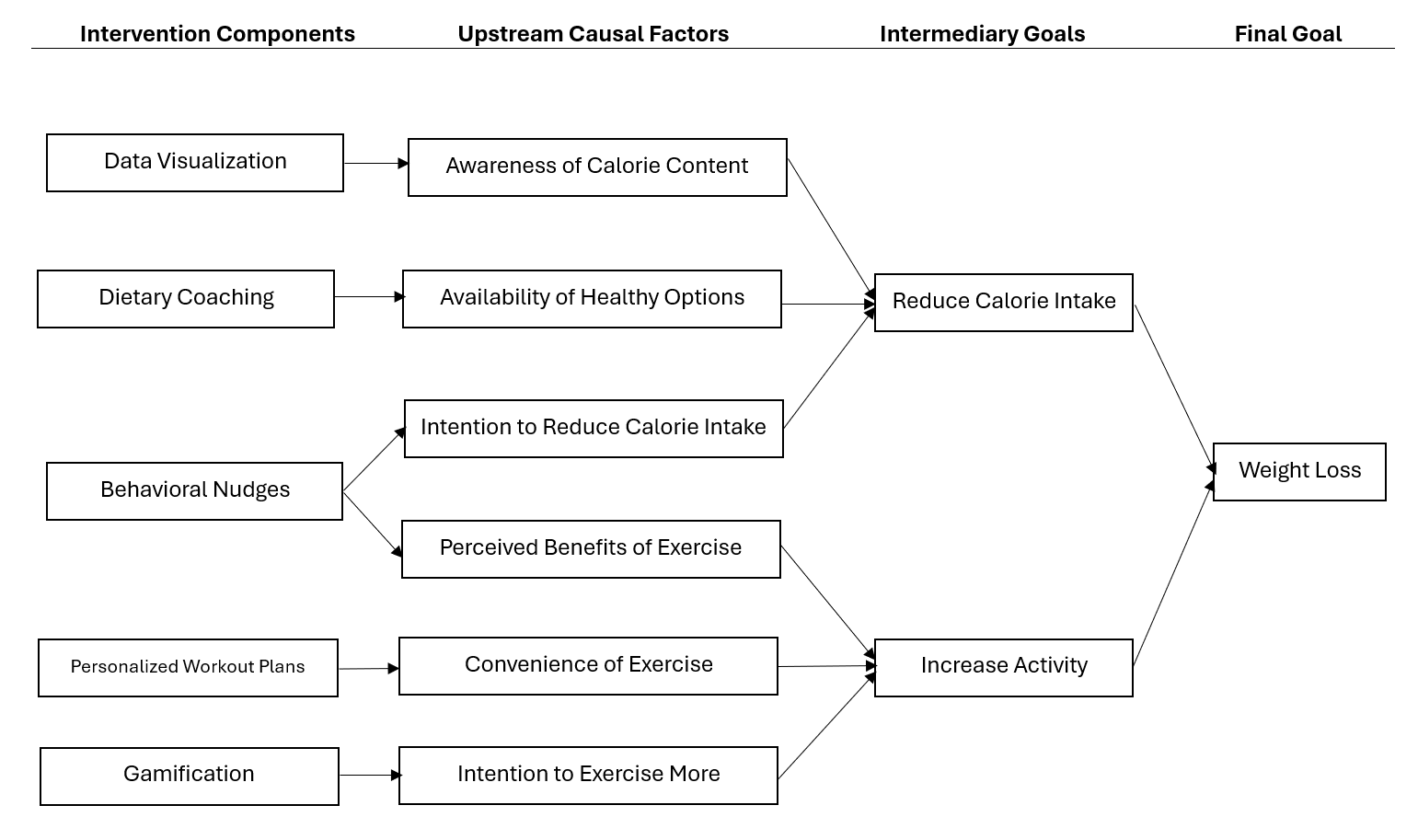
Evaluate each component’s effectiveness in targeting upstream factors and intermediary goals.
Example: Compare mindfulness exercises to social support features in reducing stress levels.
Phase 2: Interaction Analysis
Analyze how combinations of components perform relative to EASE (Effectiveness, Affordability, Scalability, Efficiency) metrics.
Example: Does combining physical activity goals with mindfulness exercises yield better stress reduction outcomes?
Phase 3: Optimization
Identify the combination of components that best balances effectiveness, affordability, scalability, and efficiency.
Phase 4: Full RCT
Validate the optimized intervention through an RCT to ensure it meets EASE criteria.
Component Costs and Effects
Mindfulness Exercises
Cost: $15 per participant.
Effectiveness: Moderately reduces perceived stress and anxiety.
Scalability: High scalability through guided meditation recordings or app-based interventions.
Physical Activity Goals
Cost: $30 per participant.
Effectiveness: Strongly improves mood and reduces stress through regular movement.
Scalability: Moderate scalability; automated goal tracking can be implemented, but sustained user engagement is required.
Social Support Features
Cost: $25 per participant.
Effectiveness: Enhances emotional resilience and reduces stress through peer interactions.
Scalability: High scalability when using community-based or AI-driven support features.
Example Outcome of Optimization
Mindfulness Exercises ($15) + Physical Activity Goals ($30) + Social Support ($25):
Total Cost: $70 per participant.
Effectiveness: High; addresses stress reduction through cognitive, behavioral, and social mechanisms.Mindfulness Exercises ($15) + Gamification ($20) + Social Support ($25):
Total Cost: $60 per participant.
Effectiveness: Moderate; enhances adherence and engagement with stress management tools.Physical Activity Goals ($30) + Data Visualization ($10) + Social Support ($25):
Total Cost: $65 per participant.
Effectiveness: Moderate; combines stress-relieving movement with self-monitoring and social accountability.
Selected Subset
Mindfulness Exercises + Physical Activity Goals + Social Support Features
Cost: $70 per participant.
Effectiveness: Maximized within budget, combining cognitive, behavioral, and social approaches to stress reduction.
| Aspect | Optimization Trial | Evaluation Trial |
|---|---|---|
| Purpose | Identifies which components of the intervention work best and under what conditions. | Assesses the overall effectiveness of the finalized intervention package. |
| Stage in MOST Framework | Conducted during the optimization phase to refine and select intervention components. | Conducted during the evaluation phase after the intervention has been fully designed. |
| Focus | Builds knowledge about:
|
Tests whether the combined intervention package achieves its intended outcomes (e.g., weight reduction) in the target population. |
| Design | Experimental design that systematically manipulates and tests combinations of components. | A randomized controlled trial (RCT) or quasi-experimental design to measure the intervention’s overall impact. |
| Outcome | Provides data to optimize the intervention package by balancing Effectiveness, Affordability, Scalability, and Efficiency (EASE). | Determines the overall effectiveness of the optimized intervention in achieving its primary outcome. |
| Iterative Process | Iterative; may involve testing multiple configurations of components. | Final; assesses the intervention as a fixed, fully-developed package. |
| Example Context | In the Weight Management Platform: Testing which components (e.g., Behavioral Nudges, Gamification, Dietary Coaching) or combinations work best within the $100 cost constraint. | In the Weight Management Platform: Testing whether the selected subset of components (e.g., Behavioral Nudges + Dietary Coaching + Gamification) reduces weight overall. |
Factorial Designs
One of the experimental designs well-suited for optimization trials under the Multiphase Optimization Strategy (MOST) framework is the factorial design , a method introduced nearly a century ago by Sir Ronald A. Fisher, who was later knighted for his monumental contributions to the field of statistics. Factorial designs systematically test multiple components ( factors ) of an intervention and their interactions, providing an efficient and robust way to evaluate the effects of various intervention components.
A simple example of a 2×2 factorial design involves two factors, A and B , each having two levels: "Yes" (component included) or "No" (component excluded). This setup results in four experimental conditions , each representing a different combination of factor inclusion or exclusion:
| Factor B | ||
|---|---|---|
| Factor A | No (Excluded) | Yes (Included) |
| No (Excluded) | ||
| Yes (Included) | ||
| Factor A | Factor B | Outcome |
|---|---|---|
| Excluded (No) | Excluded (No) | |
| Included (Yes) | Excluded (No) | |
| Excluded (No) | Included (Yes) | |
| Included (Yes) | Included (Yes) |
Factorial designs allow researchers to estimate three key types of effects: main effects of individual factors and the interaction effect between them.
Main Effects
A main effect represents the average impact of a factor on the outcome, independent of the presence of the other factor.
1. Main Effect of Factor A () To calculate the effect of Factor A , we compare conditions where A is included () versus conditions where A is excluded ():
This formula computes the average difference in outcomes between the inclusion and exclusion of Factor A , providing insight into whether adding this intervention component has a significant impact.
2. Main Effect of Factor B () Similarly, the effect of Factor B is calculated by comparing conditions where B is included () versus conditions where B is excluded ():
This measures the independent contribution of Factor B to the outcome.
Interaction Effects
The interaction effect () measures whether the combined presence of Factor A and Factor B produces an effect that is greater or less than the sum of their individual effects . This is crucial because some intervention components may work synergistically , meaning their joint effect is greater than expected , or they may interfere with each other, reducing their effectiveness when combined.
The interaction effect is calculated as:
This measures whether the combined influence of A and B deviates from what would be expected if their effects were simply additive. A positive interaction effect suggests that the two components enhance each other , while a negative interaction effect suggests they diminish each other’s effectiveness .
| Effect | Calculation Formula |
|---|---|
| Main Effect of A () | |
| Main Effect of B () | |
| Interaction Effect () |
Interpretation & Explanation of Effects
Computing the Change in Factor B’s Effect Due to Factor A
To see how Factor A influences the outcome when B is absent, we compute:
Similarly, to see how Factor A influences the outcome when B is present, we compute:
If there were no interaction, these two differences should be the same, meaning Factor A’s effect should be the same regardless of whether B is present or absent.
Computing the Change in Factor A’s Effect Due to Factor B
Now, we check if Factor B changes the effect of Factor A by taking the difference:
This measures how much the presence of B modifies the effect of A.
Averaging the Effect Across Both Levels
Since interaction effects represent a combined deviation, we take the average difference by dividing by 2:
Expanding the parentheses, we get the final formula:
Intuitive Explanation
Think of Factor A as a dietary intervention (e.g., reduced sugar) and Factor B as an exercise program. The interaction effect tells us whether the benefit of dieting depends on whether the person exercises:
If dieting helps people lose weight regardless of exercise, then there is no interaction.
If dieting works much better when paired with exercise than we would expect based on their individual effects, then there is a positive interaction.
If dieting actually becomes less effective when combined with exercise, then there is a negative interaction.
By using the formula, we capture whether the combined presence of A and B produces effects that are greater or less than expected based on their independent effects.
Required readings
Chapters 1–4 of Collins, L. M. (2018). Optimization of Behavioral, Biobehavioral, and Biomedical Interventions: The Multiphase Optimization Strategy (MOST). Springer. https://doi.org/10.1007/978-3-319-72206-1
Landoll, R. R., Vargas, S. E., Samardzic, K. B., Clark, M. F., and Guastaferro, K. (2022). The Preparation Phase in the Multiphase Optimization Strategy (MOST): A Systematic Review and Introduction of a Reporting Checklist. Translational Behavioral Medicine, 12(2), 291–303. https://doi.org/10.1093/tbm/ibab146