Summary of the Previous Session
In the previous session we learned how SMART optimizes the sequence of interventions and how JITAIs take this further by delivering real-time, context-sensitive interventions (e.g., via mobile devices), often relying on SMART-like decision rules to determine ’when’ and ’what’ to deliver. MRTs, the focus of today’s session, zoom in on the proximal effects of these intervention components, randomizing them repeatedly within individuals to assess their immediate impact and refine JITAIs. MRTs provide the experimental backbone to test and perfect JITAI delivery—offering a pipeline from design to real-time adaptation in mobile health interventions.
Micro Randomized Trial (MRT)
Micro-Randomized Trials (MRTs) are an experimental design framework used to assess the proximal (short-term) effects of intervention components in real time. In MRTs, participants are randomized repeatedly—often multiple times per day to different intervention options (e.g., receiving a push notification vs. no notification) at specific decision points over the course of a study. This approach allows researchers to evaluate how these components impact immediate outcomes, such as behavior or mood, and to understand how effects may vary across time or contexts. MRTs are particularly valuable in developing adaptive interventions, such as those in mobile health (mHealth), by providing data to optimize the timing, dosage, and type of support delivered to individuals.
Purpose: MRTs help us assess how specific intervention components—like mindfulness, physical activity, or peer support in our University of Miami stress-reduction app—impact students’ stress levels in real time.
Key Idea: By testing these components moment-to-moment, MRTs reveal what works, when, and for whom, enabling us to build smarter, adaptive interventions.
How Does MRT Work?
Repeated Randomizations: Participants are randomized multiple times (e.g., daily or hourly) to intervention options or a control (no intervention). Note that in many cases, we should first determine if an individual is eligible for randomization.
Decision Points: These are specific moments when the app decides what to deliver—like 8 AM, 12 PM, or 4 PM when stress might spike for UM students.
Proximal Outcomes: The immediate effects we measure—like a student’s self-reported stress level 30 minutes after a physical activity prompt.
For our app, we might randomize a student to a 5-minute breathing exercise at 12 PM, then check their stress level. Tomorrow at 12 PM, the exact same student might get a ‘walk break’ prompt instead
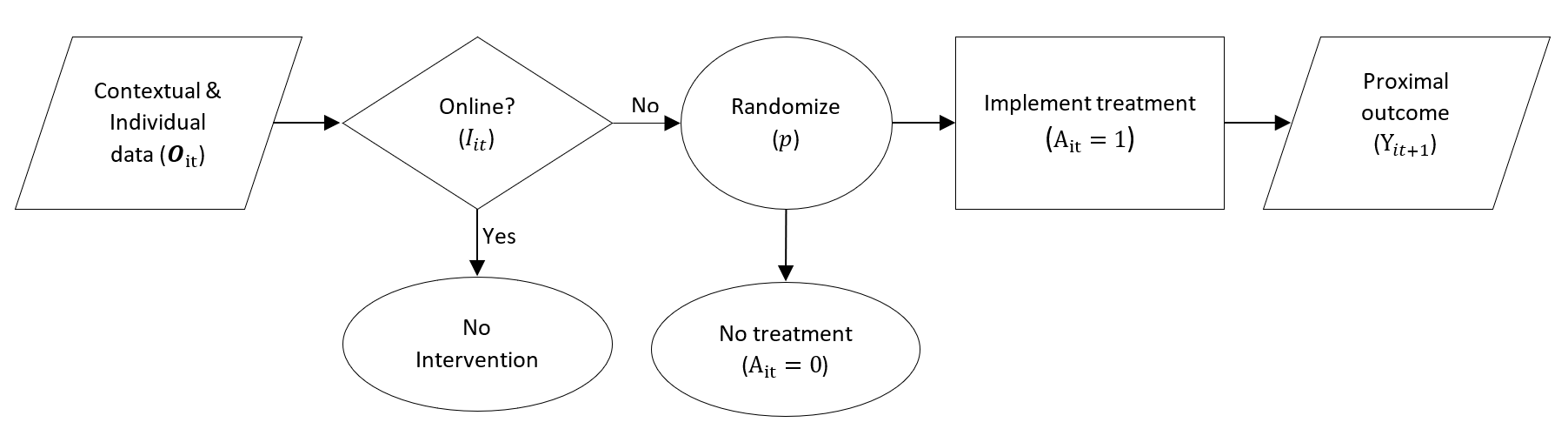
Modeling Time-Varying Effects and Endogeneity in MRTs
In MRTs, time-varying effects refer to how the impact of an intervention component (e.g., a mindfulness prompt) might change over time or across decision points—due to factors like habituation, fatigue, or cumulative effects. Endogeneity arises when the decision to deliver an intervention at a given time depends on prior states or interventions (e.g., a student’s low stress at 3 PM might result from a 12 PM prompt), making the treatment assignment non-random in a causal sense. This complicates the estimation of true proximal effects because the current intervention’s delivery is entangled with past outcomes or actions. MRTs address this through advanced statistical modeling, ensuring that causal effects are isolated despite these dependencies.
Why It’s a Problem in MRTs?
MRTs involve repeated randomizations at multiple decision points (e.g., 8 AM, 12 PM, 3 PM daily). If a student’s state at 3 PM (e.g., low stress or already walking) is influenced by a prior intervention (e.g., a walk prompt at 12 PM), then excluding them from randomization at 3 PM (due to unavailability) introduces a feedback loop. This feedback makes the treatment assignment endogenous—it’s no longer purely random but conditional on prior effects, violating the assumptions of standard causal inference models (e.g., independence of treatment assignment).
Goal of Modeling
The aim is to estimate the average proximal effect of an intervention (e.g., how much a 3 PM mindfulness prompt reduces stress by 3:30 PM) across all participants, while accounting for:
Time-varying effects: Does the prompt’s effect diminish over days as students habituate?
Endogeneity: Does the prompt’s delivery depend on prior prompts’ success?
Without adjustment, estimates could be biased—overstating or understating the true effect.
How to Address the Problem Using GEE and IPW Method
MRTs use statistical techniques like generalized estimating equations (GEE) with inverse probability weighting (IPW) to adjust for these dependencies. These methods:
Treat prior interventions and states as time-varying covariates.
Reweight the data to mimic a scenario where randomization is independent of past effects.
Model the proximal effect of a 3 PM intervention () on stress at 3:30 PM ():
: Stress at 3:30 PM (0-10).
: 3 PM intervention (e.g., Walk = 1, None = 0).
: Day (1 to 14).
: Time-varying effect.
: Stress at 3 PM.
: 12 PM intervention (e.g., Mindfulness = 1).
Fit with:
IPW: Weight , where .
GEE: AR(1) correlation for repeated measures.
Interpretation
: Average effect of walk at 3 PM (e.g., -0.9 points).
: Effect change per day (e.g., -0.05 if fading).
Adjusted for to correct endogeneity.
This ensures unbiased estimates of intervention effects, even with prior influences or time trends.
How to Address the Problem Using Weighted and Centered Least-Squares (WCLS) Method
The Weighted and Centered Least-Squares (WCLS) method estimates causal excursion effects in Micro-Randomized Trials (MRTs), focusing on proximal intervention effects in real-time digital interventions (Boruvka et al., 2018).
How It Works
Key Idea: WCLS measures the difference in
Stress_t30when an intervention (e.g., Mindfulness) is delivered versus not, among available students. It uses MRT’s repeated randomizations.Steps:
Weighting: Uses
Available() as a binary weight (1 if available, 0 if not), including only randomized time points.Centering: Centers treatment indicators around the randomization probability (). E.g.,
Mindfulness_c = Mindfulness - 0.25.Modeling: Fits .
Estimation: Solves via GEE with independence correlation matrix.
Example
At 3 PM, a student is available (Available = 1) and randomized to Mindfulness (Mindfulness_c = 0.75) or None (Mindfulness_c = -0.25). WCLS estimates the change in Stress_t30, using Prev_Intervention to reduce noise.
Advantages
Simplicity: Uses known , no complex weight modeling.
Robustness: Consistent even if controls are misspecified (Qian et al., 2020).
Limitations
Assumes randomization eliminates confounding within available cases.
Best for continuous outcomes (e.g., stress).
Implementation
In SAS, use PROC GENMOD with weight Available, centered predictors, and type=ind, as in our app’s analysis.
Required readings
Walton, A., Nahum-Shani, I., Crosby, L., Klasnja, P., and Murphy, S. (2018). Optimizing Digital Integrated Care via Micro-Randomized Trials. Clinical Pharmacology
& Therapeutics, 104(1), 53–58. https://doi.org/10.1002/cpt.1079
Liao, P., Klasnja, P., Tewari, A., and Murphy, S. A. (2016). Sample Size Calculations for Micro-Randomized Trials in mHealth. Statistics in Medicine, 35(12), 1944–1971. https://doi.org/10.1002/sim.6847
Boruvka, A., Almirall, D., Witkiewitz, K., and Murphy, S. A. (2018). Assessing Time-Varying Causal Effect Moderation in Mobile Health. Journal of the American Statistical Association, 113(523), 1112–1121. https://doi.org/10.1080/01621459.2017.1305274
NeCamp, T., Sen, S., Frank, E., Walton, M. A., Ionides, E. L., Fang, Y., Tewari, A., and Wu, Z. (2020). Assessing Real-Time Moderation for Developing Adaptive Mobile Health Interventions for Medical Interns: Micro-Randomized Trial. Journal of Medical Internet Research, 22(3), e15033. https://doi.org/10.2196/15033
Yaraghi, N., Ramesh, R., and Tayi, G. K. (2025). Pay, Pat, and Clawback: Incentivizing Service Providers’ Participation in On-Demand Digital Platforms. Management Science, 71(9), 7579–7599. https://doi.org/10.1287/mnsc.2023.02603